
There are ideas and truths that the Bible spells out so clearly, often giving us multiple teachings all to make it certain just what God has said and what God means when He says it. For instance, Jesus is very clear that He is God, that He is the only way to relationship with God. But there are other things that are not explicitly answered, “secret things that belong to the Lord” (Deuteronomy 29:29), such as “Is it lawful to remarry after one has gotten divorced?” There is a lot on divorce in the Bible, but not a lot on RE-marriage. That answer, as Paul says, “we know in part… we see in a mirror dimly…” (1 Corinthians 13:9 & 12). I just want to make clear that all my musings and wonderings on this page fall into that category – “looking into a foggy mirror” type of questions. There are no specific answers that the Bible gives. With that in mind:
I find the chapters of Genesis 4, 5, 10 and 11 fascinating. What seems like a boring list of names and years at first glance opens up such wonder for me. This is the question I started with this morning – I wondered who was alive when Adam died. The early people of the Bible before the flood all lived 600, 700 and 800 years, and after the flood 200 to 400 years. So I put together a spread sheet that would show me how their lives overlapped. I started my numbering system with Year 1, the year God created Adam. After that, the years listed in grey are the years someone was born or someone died (or as in Enoch’s case, was no more) according to the ages given in the Bible. The number at the bottom of each man’s life span is the year he died. The black line is the year of the flood.
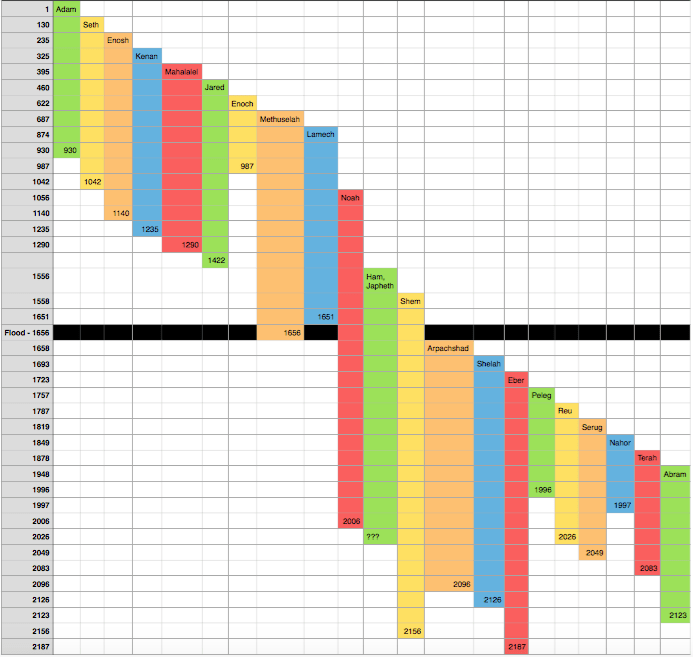
These are the things I wonder about as I notice and ponder this chart:
1. So Adam lived until after the birth of Noah’s father. All those generations could have heard first hand accounts of what it was like in the Garden of Eden. I wonder if Adam regularly gathered everyone together, or if he traveled around to all the great-great-great grandkids to tell his stories.
2. Was Methuselah part of the wicked generation that died in the flood? Or did God let him die of old age before the flood started?
3. Why did Eber (great-great grandson of Noah) live so long (464 years) when the generations that came after him lived to only half his age? Was it a gift of long life? Or was it a judgement against him to see his children, grandchildren, great-grandchildren, … great-great-great-great-grandchildren die?
4. Noah was still alive when Abram [whose name was later changed to Abraham] was born. Did Abram get the chance to talk with him and hear Noah’s stories about God speaking directly to him, telling him to build a boat? If he heard the stories from Noah, I wonder if that was a great encouragement to him to live faithfully according to God’s direction when he himself heard God speak.
5. It doesn’t feel like the book of Genesis covers that much time. But in reality, it was more than 2000 years of people and events from Adam to Abram. [Okay, that is something that Bible does give us enough information to figure out. But it’s still very interesting to ponder, and puts the first book of the Bible in a better context.]
6. Enoch was only on the earth 356 years. [And the number of years, 365, matching the number of days in a year, 365 – I also find quite interesting.] So why did God take him up “and he was no more”? Death was not part of his exit from the earth. Only one other man didn’t experience death, and that was Elijah (2 Kings 2:11). Why were those two taken up without dying?
7. While we’re thinking on Enoch and Elijah being taken up with out dying, I find it interesting that there is an idea among some of the early church fathers that Enoch and Elijah are the “Two Witnesses” spoken of in Revelation 11. I only bring it up here because I find it an intriguing idea – one that is spoken of in some of the commentaries. But I want to caution anyone who reads this: The Bible never says that explicitly – never pairs the two men with the two witnesses. Therefore, we should keep this idea in the foggy mirror category, possible but not definite.
8. And still on the subject of Enoch: how about that verse in Jude 14-16? “It was also about these that Enoch, the seventh from Adam, prophesied, saying, ‘Behold, the Lord comes with ten thousands of his holy ones, to execute judgment on all and to convict all the ungodly of all their deeds of ungodliness.…’” I find it interesting that Jude saw Enoch as a prophet. I wonder where he got that information when Genesis 5 only says, “Enoch walked with God.” Says it twice. But that men had already become wicked and godless is probably by his time; and being a man who “walked with God”, it seems equally probably that he would have spoken out against such evil behaviors and attitudes, warning his kinsmen of the coming judgement.
9. It’s not part of the chart, but in the genealogy of Cain in Genesis 4, one of his descendants, Jubal, is known as the father of the first instrumentalists. As a musician, I find it VERY interesting that this gift of instrumental music came through the line of Cain, the murderer of his brother.
I think it is worthwhile to muse through such questions as come to your mind. For some questions you can find hard and fast answers. For others, you won’t. But as you ponder the Word of the Lord, keep talking to Him about it and see if He doesn’t show you some fascinating mysteries and curious facts.
 Faith Gym